

Table of Contents
- What Is a Capsule Wardrobe and Why It Works for Beginners
- How to Declutter Your Closet for a Capsule Wardrobe
- Capsule Wardrobe Color Palette Ideas That Actually Mix
- Your Capsule Wardrobe Checklist for Beginners
- Quality Over Quantity: Here's What Actually Matters
- Building Your Capsule Wardrobe Around YOUR Body and YOUR Life
- Digital Tools That Make Your Capsule So Much Easier to Manage
- Frequently Asked Questions
Last Updated: September 28, 2026
What Is a Capsule Wardrobe and Why It Works for Beginners
Okay, let's talk capsule wardrobes. Think of it as your closet's greatest hits album: a small, thoughtfully chosen lineup of clothes that all get along and mix into a ton of outfits. Most capsules land around 30 to 40 pieces per season, and every single item has to pull its weight by pairing with at least three other pieces.
Capsule Wardrobe vs. Minimalist Wardrobe: What's the Difference?
Here's the fun distinction: a minimalist wardrobe is all about owning less, full stop. A capsule wardrobe is about owning the right stuff. Minimalism picks a number and sticks to it like a rule. A capsule picks a purpose, every piece has to mix, match, and actually earn its spot in your real life.
How to Declutter Your Closet for a Capsule Wardrobe
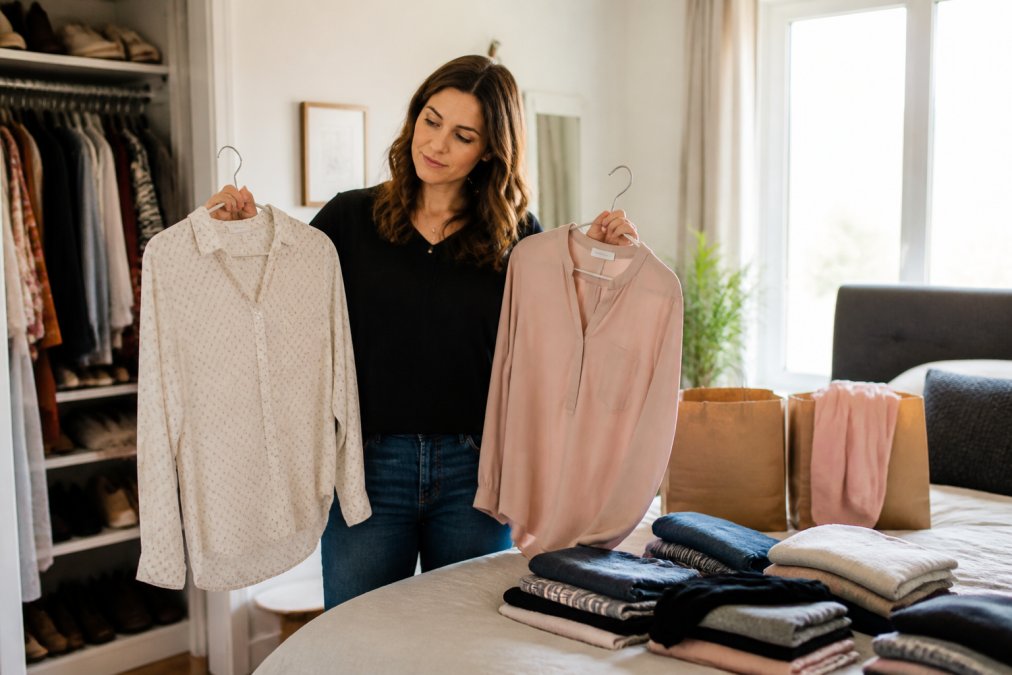
Ready to declutter? Grab a coffee, because this starts with one brutally honest pass through everything you own. Pull it all out, try it on, and sort with zero mercy. This step eats up an afternoon, and it's the one everybody wants to skip. Don't skip it.
The Three-Pile Method: Keep, Donate, Repair
Grab three piles and get sorting. Keep is for anything that fits great, makes you feel good, and you've actually worn lately. Donate is for the good stuff that just isn't you anymore. Repair is for pieces worth saving, a loose button, a hem, a broken zipper, nothing a little fixing can't handle.
What to Do With the Clothes You Remove
Where your old clothes end up actually matters, way more than most guides let on. Send wearable pieces to local charities or shelters, they'll make someone's day. Worn out fabrics can go to textile recycling programs so they skip the landfill. And plenty of retailers now run take back programs for old garments, so check before you toss anything.
Capsule Wardrobe Color Palette Ideas That Actually Mix
The best color palettes keep it simple: two or three neutral tones plus two accent colors, that's it. Neutrals like black, navy, gray, cream, and camel do the heavy lifting as your base. Then your accents swoop in to add personality without throwing off the whole coordination game.
Palette Role |
Examples |
Share of Capsule |
|---|---|---|
Core neutrals |
Black, navy, gray, cream |
70% |
Accent colors |
Olive, rust, burgundy, blush |
30% |
Metallics/prints |
Gold, subtle stripes |
Use sparingly |
Your Capsule Wardrobe Checklist for Beginners
Here's your beginner checklist, the essentials that anchor pretty much every outfit you'll build. Start here, then tweak it for your climate and your actual life.
- Tops: 5-7 pieces (tees, blouses, a button-down)
- Bottoms: 3-4 pieces (jeans, trousers, a skirt)
- Outerwear: 2-3 pieces (jacket, blazer, coat)
- Dresses: 1-2 versatile options
- Shoes: 3-4 pairs (flats, sneakers, boots, heels)
- Accessories: scarves, belts, jewelry to shift a look
How Many Items Should a Beginner Capsule Wardrobe Have?
Aim for 30 to 40 items in your first capsule, that includes shoes and outerwear but not accessories or workout gear. It's the sweet spot: enough variety to feel like a real wardrobe, without overwhelming yourself on round one.
Quality Over Quantity: Here's What Actually Matters
Here's the truth: quality over quantity comes down to construction, fabric, and fit, not the label sewn inside. Check the seams for even stitching, feel the fabric for real weight and drape, and check the buttons and zippers for hardware that's built to last.
Building Your Capsule Wardrobe Around YOUR Body and YOUR Life
If you're just starting out, forget the generic list. Your capsule wardrobe works so much better when it starts with your actual body and your actual life. That means picking cuts that flatter your proportions, and the quickest way to nail that is to anchor every category around a silhouette you already know looks good on you.
Your Go-To Cuts by Body Type
- Pear (hips wider than shoulders): Go for structured shoulders and darker bottoms, they're your best friends here. Try straight-leg or bootcut jeans, A-line skirts, and tops with a little detail at the neckline. A blazer with a defined shoulder balances everything out beautifully.
- Apple (midsection carries weight): V-necks, empire waists, and open cardigans are your secret weapon, they create that vertical line that just works. Straight-leg trousers and wrap dresses skim instead of cling, so you'll feel comfortable all day.
- Hourglass (shoulders and hips balanced, waist defined): Show off that waist. Wrap tops, belted coats, and high-waisted bottoms that follow your natural curve are the move. Skip the boxy cuts, they just hide the shape you've got.
- Rectangle (shoulders, waist, and hips similar): Time to create some curve. Peplums, belted jackets, and layered tops do the trick, and straight-leg jeans plus shift dresses make great base pieces.
- Inverted triangle (shoulders wider than hips): Soften that shoulder line with V-necks and raglan sleeves, then add volume below with wide-leg trousers or pleated skirts for balance.
Think of these as starting points, not strict rules. The real test: does a piece make you feel put-together without constant tugging or adjusting. If yes, it's earned its spot in your closet.
Map Out Your Week Before You Shop a Single Thing
Lifestyle needs come next. A remote worker's capsule looks nothing like a teacher's or a new mother's. Before buying anything, write down how many days per week you dress for each of these modes:
- Casual (errands, school pickup, weekends)
- Business casual (office, client meetings)
- Formal or dressy (events, dinners)
- Active or outdoor (gym, hiking, yard work)
Capsule Planning for Your Specific Work Vibe
Corporate formal: Anchor everything on two suits (navy and charcoal), three button-down shirts, one silk or knit shell, one pair of leather pumps or loafers, and one structured tote. Toss in a pencil skirt or tailored trousers and those two suits stretch into five completely different outfits.
Shop our Main Street Location →
The 5-4-3-2-1 Rule, Put to Work
Want a dead-simple way to start? Try the 5-4-3-2-1 rule: five tops, four bottoms, three pairs of shoes, two dresses or jumpsuits, and one outerwear piece. That's just 15 items for a seasonal mini-capsule, and it churns out roughly 60 outfit combinations once every top plays nice with every bottom. Build one season first, live in it for a month, then expand from there.
Digital Tools That Make Your Capsule So Much Easier to Manage
Here's the angle most beginner guides completely skip: a good wardrobe app beats a paper list every single time. Apps let you catalog each item, track what you actually wear, and spot the pieces gathering dust in the back of your closet. Outfit planning features basically erase those stressful morning decisions altogether.
What Your Wardrobe App Needs to Have
Most wardrobe apps have the same core features under the hood. When you're comparing options, keep an eye out for these:
- Photo catalog: Snap each item against a plain background and tag it by category, color, and season, easy peasy.
- Outfit builder: Drag items together and save your favorite combos to reuse whenever you want.
- Wear tracking: Log every time you wear a piece so you can see your cost-per-wear and spot the dead weight fast.
- Calendar view: Plan your outfits for the week ahead and catch gaps before they turn into a problem.
- Offline access: A lifesaver if you're shopping in stores with spotty signal.
Your Simple Weekly Maintenance Routine
A capsule only stays functional if you actually maintain it. Carve out 15 minutes every Sunday for these four quick steps:
- Log the week. Add any new wears to your tracker so your data stays spot-on.
- Plan the next week. Build five outfits from your capsule and jot down anything you wish you had.
- Flag gaps. Reached for the same missing item three weeks running? That's a real gap, not just an impulse.
- Rotate seasonally. When the weather shifts, tuck away the out-of-season pieces and pull in the next set.
Switching Seasons Without Starting From Scratch
Once you tag your items by season, your capsule inventory tracks the transitions for you automatically. When the weather shifts, you'll know exactly which pieces to bring in and which to store away. A popular pattern: keep 20 to 25 core items year-round (basics, denim, layering pieces) and swap in 10 to 15 seasonal items (heavy coats, linen, sandals) whenever the season turns.
Budgeting for New Pieces (Without Overspending)
Your capsule isn't a one-and-done purchase, it's ongoing. Set a quarterly budget and prioritize real gaps over things you just want. A simple rule to live by: replace worn-out staples first, fill functional gaps second, and save trend or accent pieces for last. Tracking cost-per-wear in your app makes this so much easier, since you can see exactly which pieces are earning their keep and which ones were mistakes.
Frequently Asked Questions
What is the 3-3-3 rule for a capsule wardrobe?
The 3-3-3 rule is a simple starting framework: choose 3 tops, 3 bottoms, and 3 pairs of shoes that all work together. This gives you 27 possible outfit combinations from just 9 items. It's a low-pressure way to test whether a capsule approach fits your lifestyle before committing to a full 30- or 40-piece wardrobe. Many beginners use it as a one-week trial run.
How many items should be in a beginner capsule wardrobe?
Most beginners do well with 30 to 40 items total, including tops, bottoms, dresses, outerwear, and shoes. That range covers a full season without forcing you to do laundry every few days. Start closer to 30 if you have a uniform or work-from-home schedule; lean toward 40 if you need office, casual, and evening options from the same collection.
How do I choose a color palette for my capsule wardrobe?
Pick two neutral tones as your base (think navy, black, cream, or camel) and add one or two accent colors you genuinely enjoy wearing. Every piece you buy should work with at least three others already in your closet. Hold items up together in daylight before committing. A palette that photographs well in your bedroom mirror is one you'll actually wear.
How do I start a capsule wardrobe without spending a lot of money?
Shop your own closet first. Most people find 60 to 70 percent of a capsule wardrobe already hanging in their closet once they declutter. Fill gaps with a few versatile pieces rather than a full haul. Cost-per-wear matters more than sticker price: a $60 blazer worn 40 times costs $1.50 per wear, while a $20 top worn twice costs $10 per wear.
What are the essential pieces for a capsule wardrobe?
Beginners typically need: two pairs of well-fitting jeans or trousers, one tailored blazer, three to four neutral tops, one white button-down, a little black dress or equivalent, a quality cardigan, and two pairs of shoes (one casual, one dressy). Add season-appropriate layers like a trench or puffer. These staples mix and match across nearly every occasion.
How is a capsule wardrobe different from a minimalist wardrobe?
A minimalist wardrobe focuses on owning as few items as possible, often under 20 pieces. A capsule wardrobe is a curated collection of 30 to 40 items chosen for versatility and mix-and-match potential within a season. Minimalism is about reduction; a capsule is about intentional selection. You can have a capsule wardrobe with 40 pieces and still call yourself a minimalist if every item earns its place.
What is the 5-4-3-2-1 rule for packing a capsule wardrobe?
The 5-4-3-2-1 rule is a packing formula: 5 tops, 4 bottoms, 3 dresses or layers, 2 pairs of shoes, and 1 accessory. It's designed for travel but works as a micro-capsule for a week-long trip or a trial run at home. The goal is to create at least 15 outfit combinations from 15 items, proving that fewer pieces can go further than most people expect.